
"I am rich Potosi,
Treasure of the world.
The king of all mountains,
And the envy of all kings"
Treasure of the world.
The king of all mountains,
And the envy of all kings"
To be honest, I had never heard of the city of Potosi, until the moment that I decided to extend my trip and visit Bolivia. It was only then, that I started reading about this glorious altiplano city right in the heart of Bolivia, at 4.060m above sea lever, which makes it the highest city in the world. You will have to excuse me for the lengthy post, but I really feel that the story of this city is equally outstanding and dramatic, and possibly all of us owe something small or large to this place, even if we are unaware of it.
 |
| Cerro Rico: The rich mountain. It's peak is at 4.824m |
In the pre-hispanic period, the area of Potosi was part of the Incas empire, who seemed to know of the silver hidden in the area, and had developed some primitive techniques of extracting the silver from the mines of Porco, a nearby mountain, but still Cerro Rico was mainly untouched. Even when the Spaniards colonized the area, after defeating the Incas, and Gonzalo Pizarro was assigned to become the first governor of the area, they did not immediately discover the well hidden secret of Cero Rico, despite their efforts in the mountain.
It was only after 3 years or so, around 1544, that a local named Diego Huallpa accidentally discovered a vein of silver in the mountain. When the secret leaked to the Spaniards through a friend of Diego, a new era started for Potosi.
There was so much silver in Cerro Rico, that it funded the whole operations of the Spanish empire and consecutively a large part of Europe, for over 200 years. During the same period, Potosi became the worlds wealthiest city with a population exceeding 200.000 people. The silver just seemed to be endless.
Of course there is the other side of the story....
in order to extract and process the valuable metal, lots and lots of hands were needed, and the Spaniards would use every indigenous man available and then some. In the terrible conditions of the mines, life expectancy was extremely short and workers would die either because of the brutal working conditions or by poisoning of mercury and other chemicals and gases. In addition, slaves would be brought from Africa who they would usually work at the mint and replace the mules that couldn't survive the high altitude for more than a couple of months. Historians estimate that over 8 million people (indigenous Bolivians & Africans) died in pretty much slavery conditions from 1545 and for the next 300 years at the mines of Potosi.
Today, Cerro Rico has been left pretty much dried up. There is just not enough silver for any company to invest in extracting the remaining metal. However, the mines are still active to a large extend. There are several co-operativas each one consisting of a small or large number of miners, who are still trying to extract the left overs. The conditions inside the mines have not improved from the old times, with the exception of some electric motors that are being used to carry the soil from one level to the next. The miners themselves are still exposed to the very same health hazards like 200 years ago.
Inside the mines
In case someone wants to visit the mines, there are two ways. One is to visit a private mines museum, which although is an old mine, not in operation anymore, which has been converted into a museum, and the other is to visit a "live" mine, where miners are still working. The first option is nice and safe, the second one not so much, as I discovered. Below is a text copied from Lonely planet guide, referring to the visits at the mines:
"The cooperatives are not museums but working mines that are fairly nightmarish places. Anyone planning to take a tour needs to realize that there are risks involved.....While medical experts note that limited exposure is extremely unlikely to cause any lasting health impacts, if you have any concerns whatsoever about exposure to asbestos and silica dust, you should not enter the mines. Accidents can also happen -explosions, falling rocks, runaway trolleys, etc. For all these reasons, all tour companies make visitors sign a disclaimer absolving them completely from any responsibility for injury, illness or death...."
You know, when I first read this passage, I though: "Usual lonely planet bullshitting, to scare people off", and so, I signed the disclaimer.
The first part of the tour includes a visit to the miners market, to get some presents for the miners. They are not particularly annoyed by the tourists, but they are expecting something small in return from the outer world.
After a short drive with a small minivan, we reached the entrance. Up until that point, everything was happy and nice....i did not have the slightest idea of what was coming.....
We continued to the 3rd level through some tunnels that were so narrow that I could hardly fit...suddenly it started getting hot and moist, the air was even less and we were both really struggling to stand still....this place is really hell.
Didn't even think of taking pictures....i have never felt more uncomfortable in my life....and all the gases and the dust from the mine, made things unbearable. We really had to get back....i've had enough
At some point, on the way back, we were at level 2 i think, we suddenly heard out guide shouting from behind "RUN, trolley coming....!!!!".....there was no point to pull-off, so we starting running in the tunnel, which was no higher than 1.20m, to find a bit of space....it was a nightmare!!! At that point I realized how dangerous this place is, especially for visitors and also how moderate the lonely planet description was.
Finally, we made it out safe and sound, but both shocked from what we saw and experienced during the last 2 hours in the mines. Maybe a little bit wiser too.....
The mountain has been so much excavated that there are fears that could anytime collapse. They all recognize that, but all miners live with the hope that they will discover a big vein of silver that will allow them to stop working in that hellish place.
Until then, they will continue to live a life that did not give them a lot of choices....
Hasta luego!
 |
| The locals say: If you are a miner, you will either die at the mines or at the hospital |
It was only after 3 years or so, around 1544, that a local named Diego Huallpa accidentally discovered a vein of silver in the mountain. When the secret leaked to the Spaniards through a friend of Diego, a new era started for Potosi.
There was so much silver in Cerro Rico, that it funded the whole operations of the Spanish empire and consecutively a large part of Europe, for over 200 years. During the same period, Potosi became the worlds wealthiest city with a population exceeding 200.000 people. The silver just seemed to be endless.
Of course there is the other side of the story....
 |
| The old Mint (Casa de la Moneda) has been converted into a magnificent museum. This was the room where the metal was melted and formed into bars to be transfered to Spain. |
in order to extract and process the valuable metal, lots and lots of hands were needed, and the Spaniards would use every indigenous man available and then some. In the terrible conditions of the mines, life expectancy was extremely short and workers would die either because of the brutal working conditions or by poisoning of mercury and other chemicals and gases. In addition, slaves would be brought from Africa who they would usually work at the mint and replace the mules that couldn't survive the high altitude for more than a couple of months. Historians estimate that over 8 million people (indigenous Bolivians & Africans) died in pretty much slavery conditions from 1545 and for the next 300 years at the mines of Potosi.
 |
| More than 2.000 mules per year were brought from the regions of Cordoba & Salta to operate the huge machinery at the mint. They wouldn't live for more than two months though at this altitude. |
Today, Cerro Rico has been left pretty much dried up. There is just not enough silver for any company to invest in extracting the remaining metal. However, the mines are still active to a large extend. There are several co-operativas each one consisting of a small or large number of miners, who are still trying to extract the left overs. The conditions inside the mines have not improved from the old times, with the exception of some electric motors that are being used to carry the soil from one level to the next. The miners themselves are still exposed to the very same health hazards like 200 years ago.
 |
| There are many semi-modern processing plants around the mountain. The miners are selling by the tone the extract from the mountain. Lots of chemicals in there.... |
 |
| This is about 25-35% pure silver. According to the miners, Bolivia, for various reasons, does not have the technology to further process it, so they send it to Chile or Peru. |
Inside the mines
In case someone wants to visit the mines, there are two ways. One is to visit a private mines museum, which although is an old mine, not in operation anymore, which has been converted into a museum, and the other is to visit a "live" mine, where miners are still working. The first option is nice and safe, the second one not so much, as I discovered. Below is a text copied from Lonely planet guide, referring to the visits at the mines:
"The cooperatives are not museums but working mines that are fairly nightmarish places. Anyone planning to take a tour needs to realize that there are risks involved.....While medical experts note that limited exposure is extremely unlikely to cause any lasting health impacts, if you have any concerns whatsoever about exposure to asbestos and silica dust, you should not enter the mines. Accidents can also happen -explosions, falling rocks, runaway trolleys, etc. For all these reasons, all tour companies make visitors sign a disclaimer absolving them completely from any responsibility for injury, illness or death...."
You know, when I first read this passage, I though: "Usual lonely planet bullshitting, to scare people off", and so, I signed the disclaimer.
 |
| Our clothes, including shoes, don't stand a chance in the mines. Hard plastic overcoats, helmets with lamps, boots and ready to go |
The first part of the tour includes a visit to the miners market, to get some presents for the miners. They are not particularly annoyed by the tourists, but they are expecting something small in return from the outer world.
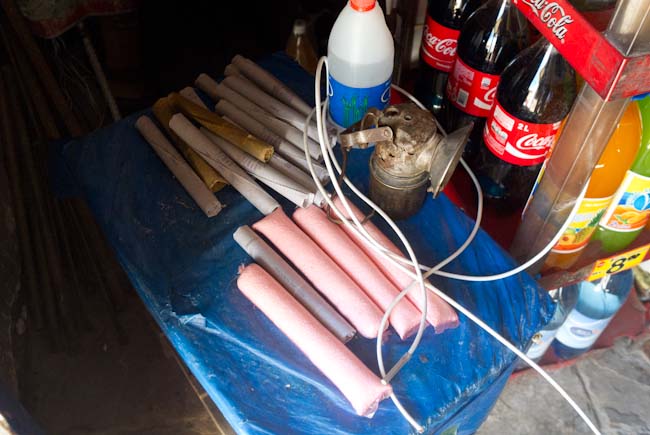 |
| Dynamite!! is one of the presents they are particularly happy about. However there is an effort to stop the explosions at the mountain so we did not buy any. Water, softdrinks, a few pairs of clothes and..... |
 |
| ......coca !! The miners live with coca. They eat nothing all day. Instead, they chew coca all day. Chewing coca apparently makes you not feeling hungry, and gives them all the energy they need |
After a short drive with a small minivan, we reached the entrance. Up until that point, everything was happy and nice....i did not have the slightest idea of what was coming.....
 |
| At the entrance....this is the first level. We are just following the rails... |
 |
| starts getting a bit cramped and the air thinner....breathing is getting harder Kara, the American girl that we did the tour together is 1.70m and she hardly fits |
 |
| we need to crawl to get down to level 2.....its getting harder and harder and the dust makes things much worse. We removed the masks we had to be able to breath |
 |
| the first miner we met....bare-handed, like most them; he was 20 years old and working for 4 years already. a bag of coca leaves and some water made him extremely happy |
 |
| wagons come and go all the time....timing can be life-saving here because they don't stop and the pull-out points are not that many |
 |
| this is the entrance to go down to level 3. at this point i can hardly hold the camera to take pictures. we stop every 100m to take some breaths. at times, i thought i would faint from the lack of oxygen....and yes, some rocks were falling, not on our heads thankfully |
 |
| but people have to work down here....chewing coca !!! This group was part of one of the largest cooperatives. They were extracting 40 tons per day. On a monthly basis, this translates to 4.000 Bolivianos per month ($500), when the salary of an educated person is around 2.000 Bolivianos. Of course, small cooperatives make half of this. I really feel bad taking pictures of them while they are working so hard, so i took only this one |
We continued to the 3rd level through some tunnels that were so narrow that I could hardly fit...suddenly it started getting hot and moist, the air was even less and we were both really struggling to stand still....this place is really hell.
Didn't even think of taking pictures....i have never felt more uncomfortable in my life....and all the gases and the dust from the mine, made things unbearable. We really had to get back....i've had enough
At some point, on the way back, we were at level 2 i think, we suddenly heard out guide shouting from behind "RUN, trolley coming....!!!!".....there was no point to pull-off, so we starting running in the tunnel, which was no higher than 1.20m, to find a bit of space....it was a nightmare!!! At that point I realized how dangerous this place is, especially for visitors and also how moderate the lonely planet description was.
 |
| we glued ourselves of the rocks on the left, to let the trolley pass... |
 |
| the cables that run across the tunnel are for compressed air. there is no electricity or additional air supply in the mines |
Finally, we made it out safe and sound, but both shocked from what we saw and experienced during the last 2 hours in the mines. Maybe a little bit wiser too.....
The mountain has been so much excavated that there are fears that could anytime collapse. They all recognize that, but all miners live with the hope that they will discover a big vein of silver that will allow them to stop working in that hellish place.
Until then, they will continue to live a life that did not give them a lot of choices....
Hasta luego!


